Start Now

Resources we save today only going to be our future resources. So, don't waste and destroy nature. Start now to Save.. Nature...

Friday, 19 August 2011

Causes and Effects of Deforestation

Trees are one of the most important aspects of the planet we live in. Trees are vitally important to the environment, animals, and of course for us humans. They are important for the climate of the Earth, they act as filters of carbon dioxide, they are habitats and shelters to millions of species, and they are also important for their aesthetic appeal. However, the trees on our planet are being depleted at a very fast rate. According to some estimates, more than 50 percent of the tree cover has disappeared due to human activity.
Although humans have been practicing deforestation since ages, it was in the mid-1800s that forests began to be destroyed at an unprecedented rate. They are important for the climate of the Earth, they act as filters of carbon dioxide, they are habitats and shelters to millions of species, and they are also important for their aesthetic appeal. However, the trees on our planet are being depleted at a very fast rate. According to some estimates, more than 50 percent of the tree cover has disappeared due to human activity. As a matter of fact, throughout the earlier part of the medieval age, Europeans used to live amongst vast areas of forested land. But later, they began deforestation at such a high rate that they started to run out of wood for cooking and heating. Also, due to the depletion of their natural habitat, wild game too began disappearing, which the Europeans largely depended upon for their nutritional requirements. Today, parallels can clearly be observed in the deforestation that is occurring in most developing countries.

One of the most worrying factors today is the massive destruction of the rainforests of the world, which is affecting the biodiversity adversely, as well as being one of the major contributory factors of the Holocene mass extinction that is ongoing.

What are the Causes of Deforestation?


The destruction of the forests is occurring due to various reasons, one of the main reasons being the short term economic benefits. Given below are some more common causes of deforestation:


Used for Urban and Construction Purposes:
The cutting down of trees for lumber that is used for building materials, furniture, and paper products. Forests are also cleared in order to accommodate expanding urban areas.

To Grow Crops:
Forests are also cut down in order to clear land for growing crops.

To Create Grazing Land:
Forests are cut down in order create land for grazing cattle.

Used for Fuel:
Trees are cut down in developing countries to be used as firewood or turned into charcoal, which are used for cooking and heating purposes.

Some of the other causes of deforestation are: clearing forests for oil and mining exploitation; to make highways and roads; slash and burn farming techniques; wildfires; and acid rain.


What are the Effects of Deforestation?


There are a number of adverse effects of deforestation, such as:


Erosion of Soil:
When forest areas are cleared, it results in exposing the soil to the sun, making it very dry and eventually, infertile, due to volatile nutrients such as nitrogen being lost. In addition, when there is rainfall, it washes away the rest of the nutrients, which flow with the rainwater into waterways. Because of this, merely replanting trees may not help in solving the problems caused by deforestation, for by the time the trees mature, the soil will be totally devoid of essential nutrients. Ultimately, cultivation in this land will also become impossible, resulting in the land becoming useless. Large tracts of land will be rendered permanently impoverished due to soil erosion.

Disruption of the Water Cycle:
Trees contribute in a large way in maintaining the water cycle. They draw up water via their roots, which is then released into the atmosphere. A large part of the water that circulates in the ecosystem of rainforests, for instance, remains inside the plants. When these trees are cut down it results in the climate getting drier in that area.

Loss of Biodiversity:
The unique biodiversity of various geographical areas is being lost on a scale that is quite unprecedented. Even though tropical rainforests make up just 6 percent of the surface area of the Earth, about 80-90 percent of the entire species of the world exist here. Due to massive deforestation, about 50 to 100 species of animals are being lost each day. The outcome of which is the extinction of animals and plants on a massive scale.

Flooding and Drought:
One of the vital functions of forests is to absorb and store great amounts of water quickly when there are heavy rains. When forests are cut down, this regulation of the flow of water is disrupted, which leads to alternating periods of flood and then drought in the affected area.

Climate Change:
It is well known that global warming is being caused largely due to emissions of greenhouse gases like carbon dioxide into the atmosphere. However, what is not known quite as well is that deforestation has a direction association with carbon dioxide emissions into the atmosphere. Trees act as a major storage depot for carbon, since they absorb carbon dioxide from the atmosphere, which is then used to produce carbohydrates, fats, and proteins that make up trees. When deforestation occurs, many of the trees are burnt or they are allowed to rot, which results in releasing the carbon that is stored in them as carbon dioxide. This, in turn, leads to greater concentrations of carbon dioxide in the atmosphere.

Tuesday, 16 August 2011

Ozone Layer : Its Depletion, Consequences & Protection

Ozone is an unstable blue gas having pungent odour. Chemically, it is an allotrope of Oxygen which is an element in the gaseous form. It has three oxygen atoms in its single molecule and in the language of Chemistry; its molecular formula is 03. It is used as a powerful oxidant, bleach, and water purifier. It is also used to treat industrial wastes.

Where is ozone found?
If found in the troposphere; ozone acts as a powerful pollutant. But, when found in the stratosphere, it acts like a friend of the earth because it shields most of the ultra violet radiations and does not allow them to pass on towards the same. In stratosphere, it is found in the form of a dense layer called as the Ozone Layer or the Ozone Belt. Thus, the Ozone Belt in the stratosphere acts like a Protective Umbrella of the earth. Let us see, how this gas is formed in the atmosphere.

How is ozone formed?
Ozone is formed in the stratosphere when oxygen molecules Photo dissociate after absorbing an UV Photon of shorter wavelength(less than 240 nm) to produce two oxygen atoms. Ozone is mainly produced from oxygen containing molecules such as Sulphur dioxide, Nitrogen Oxides, etc. also when these molecules are exposed to ultraviolet radiations. In Chemistry, a molecule is the particle of any substance that can remain in a free state. But, what is an atom? Well, an atom is the smallest particle of a substance that can not usually remain in a free condition. Two or more atoms combine to form a molecule. Through the foregoing lines, we came across another term, allotrope. One of the two or more different forms of molecules of an element is called as an allotrope.
A large number of ozone molecules assemble around the earth to form the Ozone Layer which extends from 13 to 48 km above the earth surface. On an average, it is about 230 Dobson units (DU) in thickness. DU is the unit which measures thickness of the ozone layer. It equals to 0.01 mm.

Ozone depleting substances
Chlorofluorocarbons (CFCs or Freons), Methane, Nitrous Oxides (N2O), Carbon Tetrachloride (CCl4), Methyl Bromide (a soil fumigant and insecticide), aircraft emissions, n- propyl bromide and Halon- 1202 are major agents that cause depletion of ozone layer. Hence, these are called as Ozone Depleting Substances (ODS).
 
How is the Ozone Layer Depleted?
Chlorofluorocarbons or Freons get accumulated in greater amounts at high altitudes and gradually reach to the stratosphere. Under the influence of intense short wave ultraviolet radiations they release chlorine atoms. A single chlorine atom can react with more than, 100,000 molecules of ozone and can convert them into oxygen. Other ozone depleting substances like methane, nitrous oxide, methyl bromide etc. too, pass through a series of reactions under the influence of UV-radiations of sunlight and catalysts found in the air and help in the depletion of ozone layer.
  • Ozone molecule absorbs UV light between 310 and 200 nm. The ozone molecule absorbs oxygen atom to form two molecules of Oxygen, and the Ozone cycle continues.
  • Ozone is destroyed by a number of free radicals catalysts –like Hydroxyl radical, Nitric oxide radical, and Bromine through natural and anthropogenic sources.

Effects of the Depletion of Ozone Layer

I. General Effects
Ozone absorbs ultraviolet radiations so that much of it is never allowed to reach to the earth surface. The protective umbrella of ozone layer in the stratosphere protects the earth from harmful ultraviolet radiations. Ozone plays an important role in the biology and climatology on the earth’s environment. It filters out all the radiations that remain below 3000Å. Radiations below this wavelength are biologically harmful. Hence any depletion of ozone layer is sure to exert catastrophic impacts on life in the biosphere. The Ultraviolet radiation is one of the most harmful radiations contained in the sunlight. Ozone layer in the stratosphere absorbs these radiations and does not allow it to reach to the earth.

The depletion of Ozone layer may lead to UV exposures that may cause a number of biological consequences like Skin Cancer, damages to vegetation, and even the reduction of the population of planktons (in the oceanic Photic zone).

Some of the remarkable effects of the UV radiations or the effects of depletion of the Ozone Layer are mentioned below.

(1) UV radiation causes sun- eye- diseases (cataract), skin diseases, skin cancer and damage to immune system in our body.

(2) It damages plants and causes reduction in crop productivity.

(3) It damages embryos of fish, shrimps, crabs and amphibians. The population of salamanders is reducing due to UV-radiations reaching to the earth.

(4) UV- radiations damage fabrics, pipes, paints, and other non-living materials on this earth.

(5) It contributes in the Global Warming. If the ozone depletion continues, the temperature around the world may rise even up to 5.5 Celsius degrees.

II.Specific Effects

The specific effects of depletion of Ozone Layer have been observed on Human Society, Agriculture, Plants and Animals etc. These effects have been summarized as below-

A. Effects of Ozone Depletion on Human Society

(i).The flux of ultra violet radiation in the biosphere is increased due to ozone depletion. It has seriously harmful effects on human societies like formation of patches on skin and weakening of the human immune system.

(ii). It may cause three types of skin cancer like basal cell carcinoma, squamous cell carcinoma and melanoma. A 10 per cent decrease in stratospheric ozone has been reported to cause 20 to 30 per cent increase in cancer in human society. Each year, about 7000 people die of such diseases each year in USA. About 10 percent increase in skin cancer has been reported in Australia and New Zealand.

(iii).Exposure to UV radiations damages skin of the sun-bathing people by damaging melanocyte-cells or by causing sun-burns due to faster flow of blood in the capillaries of exposed areas.

(iv).Exposure to UV radiations due to ozone depletion may cause leukemia and breast cancer.

(iv).Exposure of UV radiation to human eye damages cornea and lens leading to Photo keratitis, cataract and even blindness.

(v).The Ambient Ozone Exposure may cause Emphysema, bronchitis, asthma and even obstruction of lungs in human beings.

(vi).Exposure to radiations due to ozone depletion has been reported to cause DNA breakage, inhibition and alteration of DNA replication and premature ageing in human beings.

B. Effect of Ozone Depletion on Agriculture
(i). Radiations reaching to the earth due to ozone depletion cause severe damage to plants including crops. As per reports, ultra violet radiations reaching to the earth cause losses up to 50 per cent in European countries.

(ii).The radiation reaching to the earth due to the depletion of the ozone layer cause visible damages in plants. They adversely affect the rate of photosynthesis that finally results into decrease in the agricultural production.

(iv).The UV radiation enhances the rate of evaporation through stomata and decreases the moisture content of the soil. This condition adversely affects the growth and development of crop plants and reduces the crop yield.

(v). The ozone reduction adversely affects the weather pattern which in turn affects the crop production by encouraging plant injuries and disease development.

(vi). The UV radiation reaching to the earth surface alters the global balance between radiation and energy. This condition of imbalance causes seasonal variations that further reduce the crop production.

(vii). A number of economically important plant species such as rice, depend on cyanobacteria residing in their roots for the retention of nitrogen. These bacteria are sensitive to UV light and they are hence, are killed instantly.

C. Effects of Ozone Depletion on other Plants and Animals
(i).The ozone layer depletion causes climatic alterations that cause physiological changes in plants and animals. The change in the energy balance and radiation may affect the survival and stability of living organisms.

(ii).The depletion of ozone layer may cause changes in thermal conditions of the biosphere. It may affect type, density and stability of vegetation which in turn may affect different bio-geo-chemical cycles operating in nature. Interruption in these cycles damages important process of ecosystem leading to dangerous conditions for plants and animals.

(iii).The depletion of ozone layer causes death of plankton- populations in fresh as well as marine waters .This condition seriously affects the transfer of materials in ecosystems. The recent researches gave analyzed a widespread extinction of planktons 2 million years ago that coincided with the nearby supernova. Planktons are particularly susceptible to effects of UV light and are vitally important to the marine food webs.

The Ozone Hole
The hole in the context of ozone depletion relates to thinning of the ozone layer in a certain area. Here, the word hole is considered as a hole in the ground which in the context of ozone layer is thinning of ozone in a certain area up to certain depth as measured by scientists. In fact, ozone hole is an area where the ozone concentration drops to an average of about 100 Dobson Units. The word ‘Dobson’ has been taken from the name of the famous scientist and climatologist G. M. B. Dobson, who observed the ozone hole for the first time in 1956, over Halley Bay.

The satellite measurements done in September 2000 revealed that the thinning of ozone layer in Antarctic had reached a record 28.3 million sq km which was about one million sq km greater than the record of 1998. Thinning of ozone in such a big area is rightly termed as ozone hole. The ozone hole in the Northern Latitudes has also been recorded. The ozone hole over Antarctica may expose not only the Antarctica but also a large area of the pacific and Atlantic oceans and South America as well.

The ozone hole over Antarctica was first discovered by Farman, Gardiner and Shanklin in 1985. They jointly declared their findings through a paper published in the May issue of Nature (an important International Journal) in 1985. The entire scientific community was shocked to know their findings.

On the basis of observations made through a network of ground based Dobson Spectrophotometer, an International Panel of scientists confirmed that the Ozone Layer was being depleted at all latitudes out side the tropics. Out of a big group of scientists across the world, Crutzen, Molina, and Rowland were awarded the Nobel Prize in Chemistry for their work on Stratospheric Ozone, in 1995.The scientific assessment of ozone depletion is going on across the world since 1981, under the sponsorship of the United Nations Environment Programme (UNEP), and the most recent measurement was done during the year 2006. Here are the comparative pictures showing the Ozone Holes over Antarctica during the spring seasons of two different years.

Why is the Ozone Hole over Antarctica, usually formed during spring months?

A circulation pattern of gases traps the ozone over the South Pole for several months but not during winter. This circulation pattern is called as Antarctic Polar Vortex. Within this vortex, the substantial ozone loss was detected for the first time during 1980. During extreme cold conditions, the polar winters are dark and continue up to three months without solar radiations. This leads to the decrease in temperature. The polar vortex traps air and contributes in further falling temperature which goes down up to -80 0c. The low temperature forms cloud particles that contain nitric acid and ice. These clouds provide surfaces for chemical reactions that lead to ozone depletion. During the Antarctic winters and springs, reactions that take place on the surface of the Polar Stratospheric Clouds (PSCs) convert pollutants into free radicals such as Cl and ClO.

These clouds can also remove NO2 from the atmosphere by converting it to nitric acid. It prevents the newly formed ClO from being converted back into ClONO2. The role of sunlight is the fundamental reason why the Antarctic ozone depletion is greatest during spring. The Antarctic ozone depletion is caused during September to early December. Over 50 per cent of the lower stratospheric ozone is destroyed during the period of the Antarctic Spring.

Prevention and Control of Depletion of the Ozone Layer
Banning the production and use of ozone depleting substances is one important way of preventing further depletion of the ozone layer in the stratosphere. On the other hand, alternatives to these chemical compounds should also be searched out so as to replace these chemicals. Scientists of the University of California, U.S.A. devised a possible way of plugging the ozone hole by injecting alkanes or propanes into the atmosphere of Antarctica. The alkanes have the affinity of reacting with ozone destroying chlorine atoms. According to the scientists, about 50,000 tones of alkane or propane would have to be blown to check the ozone loss. These chemicals could be released from an altitude of about 15 km by a group of hundreds of large aircrafts.

Global Efforts for Controlling the Depletion of the Ozone Layer
Since ozone depletion is a Global Environmental Problem, it requires strong global efforts and co- operations for its solution. The International Community is taking up strong efforts as a result of which global consumption of ozone depleting substances has decreased markedly.
Following the UNEP’s Governing Council’s meeting to co- ordinate activities on protecting ozone layer in 1975, United States, Canada, Norway and Sweden banned the use of CFCs. The production capacity of the European Union (E U) was frozen allowing limited uses of aerosols. In March 1985, 28 countries of the world agreed on Vienna Convention for the protection of the ozone layer. In September 1987, different countries of the world adopted Montreal Protocol on substances that deplete ozone layer. The General Assembly of the United Nations voted to designate September 16 as the World Ozone Day, to mark the signing of the Montreal Protocol, the 16th September, 1987.By December 2001, 182 countries ratified the Vienna Convention and 181 the Montreal Protocol. By 2000, 96 chemicals were subject to control under the Montreal Protocol.

Wednesday, 10 August 2011

Energy Conservation

Energy conservation is the reduction of quantity of energy used. Energy conservation supports the eco friendly lifestyle by providing energy, which saves your money and at the same time saves the earth. When you decrease the amount of energy you use you automatically make efforts to reduce increasing global warming.

Source of Energy Conservation

Solar Energy
Solar power uses the sun's energy and light to provide heat, light, and electricity for homes. It is the primary source of all energy forms on the earth. It is one such energy which helps in maintaining the ecological balance through the process of photosynthesis and green house effect. We have been using sun to dry clothes and boil food for generations. But now number of techno powers which have been developed to make full use of solar energy such as : -
  1. Photovoltaic systems : By these systems the electricity could be produced directly from the sunlight.
  2. Solar Process Space heating and cooling : It is the commercial and industrial use of sun's heat.
  3. Solar Hot Water : The process to heat water with the solar energy.
  4. Solar Power plants : Producing electricity bu using the sun's heat.
  5. Passive Solar heating and daylighting : Use solar energy to heat buildings.
 
Energy Conservation
Wind energy
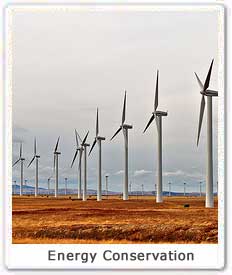
Wind energy is often used to generate the mechanical power or the electricity. In the country like India, wind energy holds the great importance because of large hilly, coastal and desert areas. In the rural areas it is used to pump water and grind grain. The benefit of wind energy is that it is fully pollution free and is eco friendly too. It costs low and the generation of power is continuous. It is the most effective way to conserve the energy and prevent the environment.

Geothermal Energy
Geothermal energy is used in the form of thermal energy, electrical energy, nuclear energy, mechanical energy, chemical energy and light energy. It uses heat energy from beneath the surface of the earth. It was first used to produce electricity in the Itlay in 1903. Geothermal energy has the major environment benefit as it prevents air pollution. It is particularly important in the inland nations such as Indian Oceans and the pacific regions. Energy generation from geothermal sources is only possible in few places under unique geographic conditions.

 
Wave energy
Ocean waves contain large amount of energy, which can be extracted through Ocean winds, Ocean currents, Ocean Geothermal etc. if the barrage is built across the river, electricity can be obtained by by the flow of water through turbines as the tide rise and falls.

Biomass energy
Biomass is the plant and animal waste which is used as the energy. Biomass energy like manure from livestock, plant waste etc can be used to generate electricity, fuel, light, and heat. We get biomass energy directly from plants and indirectly from the animal waste.

Hydroelectric energy
Another renewable source of energy is the hydroelectric energy, which is produced from fast flowing water. The process is pollution free. The movement of water spins the turbines which in turn generate electricity.

Tuesday, 9 August 2011

Global Warming Cause and Effect

The average facade temperature of the glob has augmented more than 1 degree Fahrenheit since 1900 and the speed of warming has been almost three folds the century long average since 1970. This increase in earth's average temperature is called Global Warming. More or less all specialists studying the climate record of the earth have the same option now that human actions, mainly the discharge of green house gases from smokestacks, vehicles and burning forests are perhaps the leading power driving the fashion.
 

The gases append to the planet's normal greenhouse effect, permitting sunlight in, but stopping some of the ensuing heat from radiating back to space. Based on the study on past climate shifts, notes of current situations, and computer simulations, many climate scientists say that lacking of big curbs in greenhouse gas discharges, the 21st century might see temperatures rise of about 3 to 8 degrees, climate patterns piercingly shift, ice sheets contract and seas rise several feet. With the probable exemption of one more world war, a huge asteroid, or a fatal plague, global warming may be the only most danger to our planet earth.

Global Warming Causes As said, the major cause of global warming is the emission of green house gases like carbon dioxide, methane, nitrous oxide etc into the atmosphere.Gasoline Causing Global WarmingThe major source of carbon dioxide is the power plants. These power plants emit large amounts of carbon dioxide produced from burning of fossil fuels for the purpose of electricity generation. About twenty percent of carbon dioxide emitted in the atmosphere comes from burning of gasoline in the engines of the vehicles. This is true for most of the developed countries. Buildings, both commercial and residential represent a larger source of global warming pollution than cars and trucks.
Building of these structures require a lot of fuel to be burnt which emits a large amount of carbon dioxide in the atmosphere. Methane is more than 20 times as effectual as CO2 at entrapping heat in the atmosphere. Methane is obtained from resources such as rice paddies, bovine flatulence, bacteria in bogs and fossil fuel manufacture. When fields are flooded, anaerobic situation build up and the organic matter in the soil decays, releasing methane to the atmosphere. The main sources of nitrous oxide include nylon and nitric acid production, cars with catalytic converters, the use of fertilizers in agriculture and the burning of organic matter. Another cause of global warming is deforestation that is caused by cutting and burning of forests for the purpose of residence and industrialization.
Annual Greenhouse Gas Emissions 
Global Warming is Inspiring Scientists to Fight for Awareness
Scientists all over the world are making predictions about the ill effects of Global warming and connecting some of the events that have taken place in the pat few decades as an alarm of global warming. The effect of global warming is increasing the average temperature of the earth. A rise in earth’s temperatures can in turn root to other alterations in the ecology, including an increasing sea level and modifying the quantity and pattern of rainfall. These modifications may boost the occurrence and concentration of severe climate events, such as floods, famines, heat waves, tornados, and twisters. Other consequences may comprise of higher or lower agricultural outputs, glacier melting, lesser summer stream flows, genus extinctions and rise in the ranges of disease vectors. As an effect of global warming species like golden toad, harlequin frog of Costa Rica has already become extinct. There are number of species that have a threat of disappearing soon as an effect of global warming. As an effect of global warming various new diseases have emerged lately. These diseases are occurring frequently due to the increase in earths average temperature since the bacteria can survive better in elevated temperatures and even multiplies faster when the conditions are favorable. The global warming is extending the distribution of mosquitoes due to the increase in humidity levels and their frequent growth in warmer atmosphere. Various diseases due to ebola, hanta and machupo virus are expected due to warmer climates. The marine life is also very sensitive to the increase in temperatures. The effect of global warming will definitely be seen on some species in the water. A survey was made in which the marine life reacted significantly to the changes in water temperatures. It is expected that many species will die off or become extinct due to the increase in the temperatures of the water, whereas various other species, which prefer warmer waters, will increase tremendously. Perhaps the most disturbing changes are expected in the coral reefs that are expected to die off as an effect of global warming. The global warming is expected to cause irreversible changes in the ecosystem and the behavior of animals.
Global Warming ProjectionsA group of scientists have recently reported on the surprisingly speedy rise in the discharge of carbon and methane release from frozen tundra in Siberia, now starting to melt because of human cause increases in earth’s temperature. The scientists tell us that the tundra is in danger of melting holds an amount of extra global warming pollution that is equivalent to the net amount that is previously in the earth's atmosphere. Likewise, earlier one more team of scientists reported that the in a single year Greenland witnessed 32 glacial earthquakes between 4.6 and 5.1 on the Richter scale. This is a disturbing sign and points that a huge destabilization that may now be in progress deep within the second biggest accretion of ice on the planet. This ice would be enough to raise sea level 20 feet worldwide if it broke up and slipped into the sea. Each day passing brings yet new proof that we are now in front of a global emergency, a climate emergency that needs instant action to piercingly decrease carbon dioxide emissions worldwide in order to turn down the earth's rising temperatures and avoid any catastrophe.
It is not easy to attach any particular events to global warming, but studies prove the fact that human activities are increasing the earth’s temperature. Even though most predictions focus on the epoch up to 2100, even if no further greenhouse gases were discharged after this date, global warming and sea level would be likely to go on to rise for more than a millennium, since carbon dioxide has a long average atmospheric life span.

Solar Panels
You Can Help Fight Global Warming
Many efforts are being made by various nations to cut down the rate of global warming. One such effort is the Kyoto agreement that has been made between various nations to reduce the emissions of various green house gases. Also many non profit organizations are working for the cause. Al Gore was one of the foremost U.S. politicians to heave an alarm about the hazards of global warming. He has produced a significantly acclaimed documentary movie called "An Inconvenient Truth," and written a book that archives his advice that Earth is dashing toward an immensely warmer future. Al Gore, the former vice president of United States has given various speeches to raise an awareness of global warming. He has warned people about the ill effects of Global warming and its remedies.

But an interesting side of the global warming episode is that there are people who do not consider global warming as something that is creating a problem. Skeptics of global warming think that global warming is not an ecological trouble. According to the global warming skeptics, the recent enhancement in the earth's average temperature is no reason for alarm. According to them earth's coastlines and polar ice caps are not at a risk of vanishing. Global warming skeptics consider that the weather models used to establish global warming and to forecast its impacts are distorted. According to the models, if calculations are made the last few decades must have been much worse as compared to actually happened to be. Most of the global warming skeptics believe that the global warming is not actually occurring. They stress on the fact the climatic conditions vary because of volcanism, the obliquity cycle, changes in solar output, and internal variability. Also the warming can be due to the variation in cloud cover, which in turn is responsible for the temperatures on the earth. The variations are also a result of cosmic ray flux that is modulated by the solar magnetic cycles.

Global Warming Skeptics
The global warming skeptics are of the view that the global warming is a good phenomenon and should not be stopped. There are various benefits of global warming according to them. According to the skeptics, the global warming will increase humidity in tropical deserts. Also the higher levels of carbon dioxide in the atmosphere trigger plant growth. As predicted, due to the global warming the sea levels will rise. But this can be readily adapted. Another argument of global warming skeptics is that earth has been warmer than today as seen in its history. The thought is that global warming is nothing to get afraid of because it just takes us back to a more natural set of environment of the past. Animals and plants appeared to do just fine in those eras of warm climate on the earth. According to few skeptics, the present chilly climate on the earth is an abnormality when judged over the geographical scale. Over geologic time, the earth’s mean temperature is 22 degrees C, as compared to today's 15.5 degrees C.